


Share this article

Table of Contents

AI’s Impact on Healthcare: A Deep Dive into the Australian Landscape

Table of Contents

AI's Impact on Healthcare: A Deep Dive into the Australian Landscape

Key Takeaways

  • AI in diagnostics enhances speed and accuracy, reducing human error.

  • Patient management is becoming more efficient through AI-driven systems.

  • Regulatory frameworks ensure the safe integration of AI in healthcare.

  • Addressing algorithmic bias is crucial for equitable AI application in healthcare.

Key Answer

AI is transforming healthcare by enhancing diagnostics and patient management, with significant advancements evident in Australian healthcare systems.

In recent years, the integration of artificial intelligence (AI) into healthcare has revolutionised how medical professionals diagnose, treat, and manage patient care. This article, *AI’s Impact on Healthcare: A Deep Dive*, explores the multifaceted transformations AI is driving within the healthcare sector, particularly focusing on Australian healthcare systems. From predictive diagnostics to enhanced patient management, AI is reshaping practices and providing new avenues for innovation and efficiency.
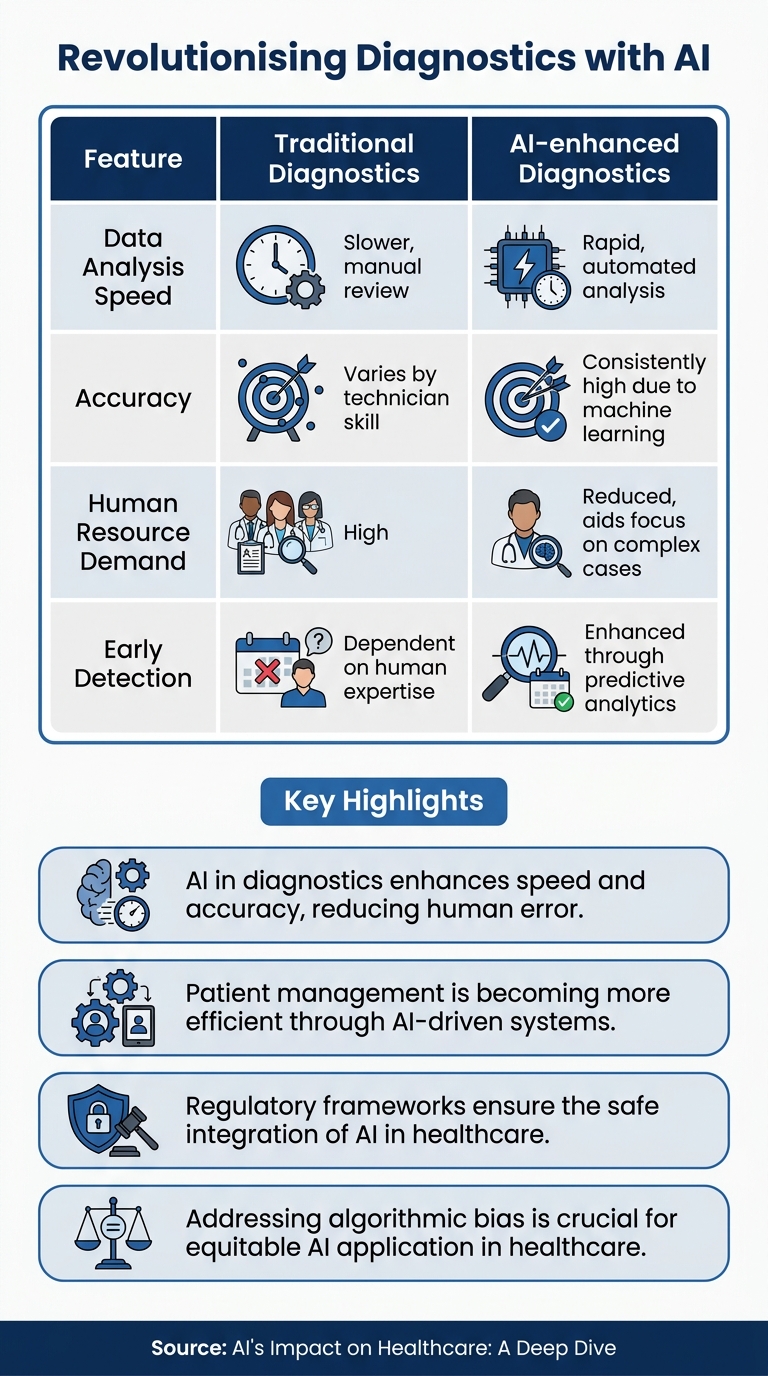
Revolutionising Diagnostics with AI

AI in diagnostics has emerged as a game-changer, offering unprecedented accuracy and efficiency. By integrating machine learning algorithms, healthcare professionals can now analyse medical images and data more effectively. For instance, AI systems can quickly detect abnormalities in radiology scans, significantly reducing the workload of radiologists and improving patient outcomes.

A notable Australian example is the collaboration between Royal Melbourne Hospital and the University of Melbourne, where AI is used to enhance brain scan analyses, increasing early detection rates of conditions like strokes and tumours. Such implementations demonstrate AI’s capacity to augment traditional diagnostic methods, leading to faster, more accurate patient care.

AI's Role in Patient Management

Beyond diagnostics, AI is significantly influencing patient management systems, enhancing efficiency and personalisation. AI algorithms can predict patient needs, optimise appointment scheduling, and even tailor treatment plans to individual genetic profiles, ensuring more personalised care.

For example, the Alfred Hospital in Melbourne has employed AI to streamline its patient scheduling system, reducing wait times and improving patient satisfaction. Moreover, AI-driven tools are being used to monitor patient vitals remotely, allowing for proactive interventions and continuous care, a boon particularly noted during the COVID-19 pandemic.

Navigating Regulatory Frameworks

Incorporating AI into healthcare systems isn’t without its challenges. Regulatory frameworks play a critical role in ensuring that AI technologies are safe and effective. In Australia, the Therapeutic Goods Administration (TGA) oversees AI medical devices, ensuring they meet stringent safety standards before being used in clinical settings.

Legal experts highlight the importance of compliance with these regulations to avoid potential liabilities. Hospitals adopting AI must also consider patient privacy laws, especially given the sensitive nature of healthcare data. Ensuring AI technologies are transparent and accountable remains a key focus to maintain public trust.

Addressing Algorithmic Bias in Healthcare

AI, while revolutionary, is not free from criticism, particularly regarding algorithmic bias. If AI systems are trained on non-representative data, they may inadvertently perpetuate healthcare inequalities. Addressing this requires robust data governance and diversity in AI training datasets.

Australian healthcare institutions are actively working to mitigate these biases. Initiatives include partnerships with indigenous communities to ensure that AI healthcare tools are inclusive and equitable. By prioritising diverse data, the healthcare sector aims to deliver fair and unbiased healthcare solutions.

Financial Implications and ROI

Investing in AI technology can be costly, but the long-term benefits often outweigh the initial expenditure. AI enhances operational efficiency, reduces errors, and improves patient outcomes, leading to significant cost savings.

A report by the Australian Digital Health Agency highlights that hospitals implementing AI have seen a 20% increase in efficiency and a notable reduction in diagnostic errors. These improvements not only enhance patient care but also increase hospital profitability, making AI a worthwhile investment for future-ready healthcare facilities.

The Future of AI in Healthcare

The future of AI in healthcare looks promising, with continuous advancements poised to further transform the industry. Emerging AI applications are exploring areas like mental health, personalised medicine, and advanced surgical robots.

As these technologies evolve, the collaboration between AI developers, healthcare professionals, and policymakers will be essential in navigating this new landscape. By maintaining a focus on ethical practices and patient-centric care, the healthcare sector can fully harness the potential of AI, ensuring benefits are maximised for all stakeholders.

Frequently Asked Questions

AI enhances diagnostics in Australia by providing faster, more accurate analyses of medical images, as demonstrated by initiatives at institutions like the Royal Melbourne Hospital.

Challenges include ensuring compliance with regulatory frameworks, managing patient data privacy, and addressing potential algorithmic biases.

AI offers financial benefits by improving operational efficiency, reducing errors, and enhancing patient outcomes, which collectively lead to cost savings and increased profitability.

AI addresses healthcare inequalities by prioritising diverse datasets in its training, helping to reduce biases and deliver equitable healthcare solutions.

The Therapeutic Goods Administration ensures that AI medical devices meet safety and efficacy standards before they are implemented in clinical settings.

Scroll to Top