

Key Takeaways
- Neptune is distinguished by its supersonic winds and long seasons, showcasing extreme planetary conditions.
- The diamond rain theory highlights the exotic chemical processes occurring in Neptune’s atmosphere.
- Neptune’s dynamic storm systems, including the Great Dark Spot, underline its volatile nature.
Key Answer
Neptune is the most distant planet in our solar system, characterised by its intense wind speeds and long seasons, making it a true planet of extremes.
Neptune: Planet of Extremes, where the ordinary transforms into the extraordinary. Located at the far edge of our solar system, Neptune stands as a testament to the universe’s untamed beauty and power. This ice giant is not merely the eighth planet from the Sun but a realm of dramatic weather phenomena, extreme conditions, and scientific mysteries yet to be fully unravelled.
In the world of astronomy, Neptune is renowned for its captivating characteristics. Its atmosphere hosts the fastest winds in the solar system, reaching speeds that would put any earthly storm to shame. Additionally, its seasons span over a century, a feature that offers a unique perspective on planetary climate dynamics.
Supersonic Winds: Unmatched Speed
Neptune boasts the fastest wind speeds in the solar system, with gusts reaching up to 2,100 km/h. Such velocities surpass the most intense hurricanes recorded on Earth, making Neptune a hotspot for dynamic atmospheric activity. These winds are believed to be driven by the planet’s internal heat and dynamic weather patterns.
The planet’s retrograde winds create a spectacle of swirling patterns and transient storms. In particular, these supersonic gusts are concentrated near the poles, creating a unique zonal wind structure. This results in a wide range of angular momentum, unmatched by any other planet in our solar system.
| Planet | Max Wind Speed (km/h) |
|---|---|
| Earth | 407 |
| Neptune | 2,100 |
| Jupiter | 620 |
| Saturn | 1,800 |
The Diamond Rain Theory
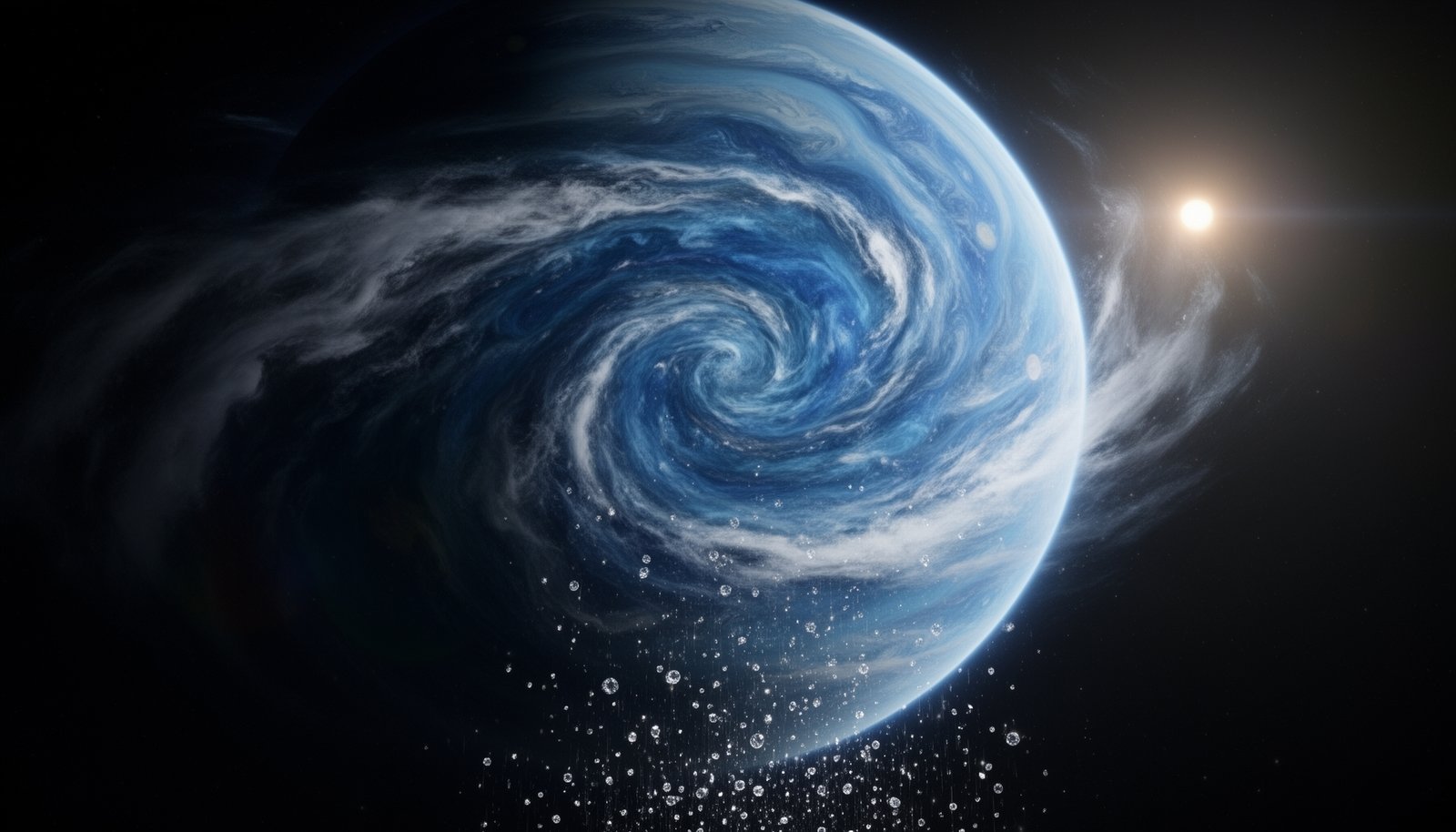
Among Neptune’s many wonders is the theorised occurrence of diamond rain. Deep within its atmosphere, extreme pressure and temperatures are believed to transform carbon into diamond crystals. These crystals then ‘rain’ down through the icy layers, a phenomenon that adds to the planet’s enigmatic allure.
This diamond rain theory stems from studies of Neptune’s atmospheric composition. The presence of methane, a compound that decomposes into carbon at high pressures, supports the possibility of diamond formation. Such a process not only captivates the imagination but also offers insights into exotic chemistry in extreme conditions.
Expert Perspective
Astronomy Expert
In the grand tapestry of our solar system, Neptune stands out as a fascinating enigma. Its extreme weather phenomena and the potential for unexplored chemical processes make it a significant focus for future exploration. Understanding Neptune not only enriches our knowledge of planetary science but also challenges our perceptions of what a planet can be.
Neptune's Seasons: A Century in the Making
Neptune’s orbital period, lasting approximately 164.8 Earth years, results in seasons that each span over four decades. This slow progression is a stark contrast to Earth’s rapid seasonal changes and allows scientists to study long-term climate trends on a planetary scale.
These extended seasons are influenced by Neptune’s axial tilt, similar to that of Earth, but magnified by its vast distance from the Sun. The planet’s frigid atmosphere, the coldest of any planet, further accentuates its seasonal extremes. These climatic cycles provide a laboratory for understanding atmospheric behaviour over extensive periods.
The Great Dark Spot and Other Storms
The Great Dark Spot is one of Neptune’s most iconic features. Discovered by Voyager 2 in 1989, this Earth-sized storm was a testament to the planet’s volatile weather. However, unlike Jupiter’s Great Red Spot, Neptune’s storm patterns are not permanent and can vanish or reappear in a matter of years.
These storms, characterized by anticyclonic rotation, highlight the planet’s dynamic atmosphere. They evolve and dissipate rapidly, presenting challenges and opportunities for astronomers seeking to understand planetary storm systems. The variations in storm activity also contribute to Neptune’s status as a planet of extremes.
| Feature | Location | Discovery Year | Duration |
|---|---|---|---|
| Great Dark Spot | Southern Hemisphere | 1989 | Disappeared by 1994 |
| Small Dark Spot | Northern Hemisphere | 2018 | Ongoing |
| Second Dark Spot | Northern Hemisphere | 1989 | Short-lived |
Future Horizons: Exploration Prospects
As our technology advances, so does the possibility of exploring Neptune up close. Future missions, like the proposed Neptune Odyssey, aim to delve deeper into its mysteries. These missions would require cutting-edge technology capable of withstanding the planet’s harsh conditions.
The challenges of reaching Neptune are immense, given its distance and hostile environment. However, the potential discoveries promise to revolutionise our understanding of the solar system. Such exploration endeavours could unveil answers about planetary formation, atmospheric dynamics, and the potential for life in extreme conditions.
Frequently Asked Questions
Neptune is known as the Planet of Extremes due to its intense atmospheric conditions, such as supersonic winds and extreme temperatures, as well as its long seasons and dynamic storm activity.
Diamond rain on Neptune is theorised to be caused by extreme pressure and temperature conditions, transforming carbon into diamonds within its atmosphere.
A season on Neptune lasts over 40 Earth years due to its long orbital period of 164.8 Earth years.
The Great Dark Spot was a massive storm system on Neptune, similar in size to Earth, which was observed by Voyager 2 in 1989 but has since disappeared.
Yes, future missions such as the Neptune Odyssey are proposed to explore the planet further, aiming to unlock more of its mysteries.