
Key Takeaways
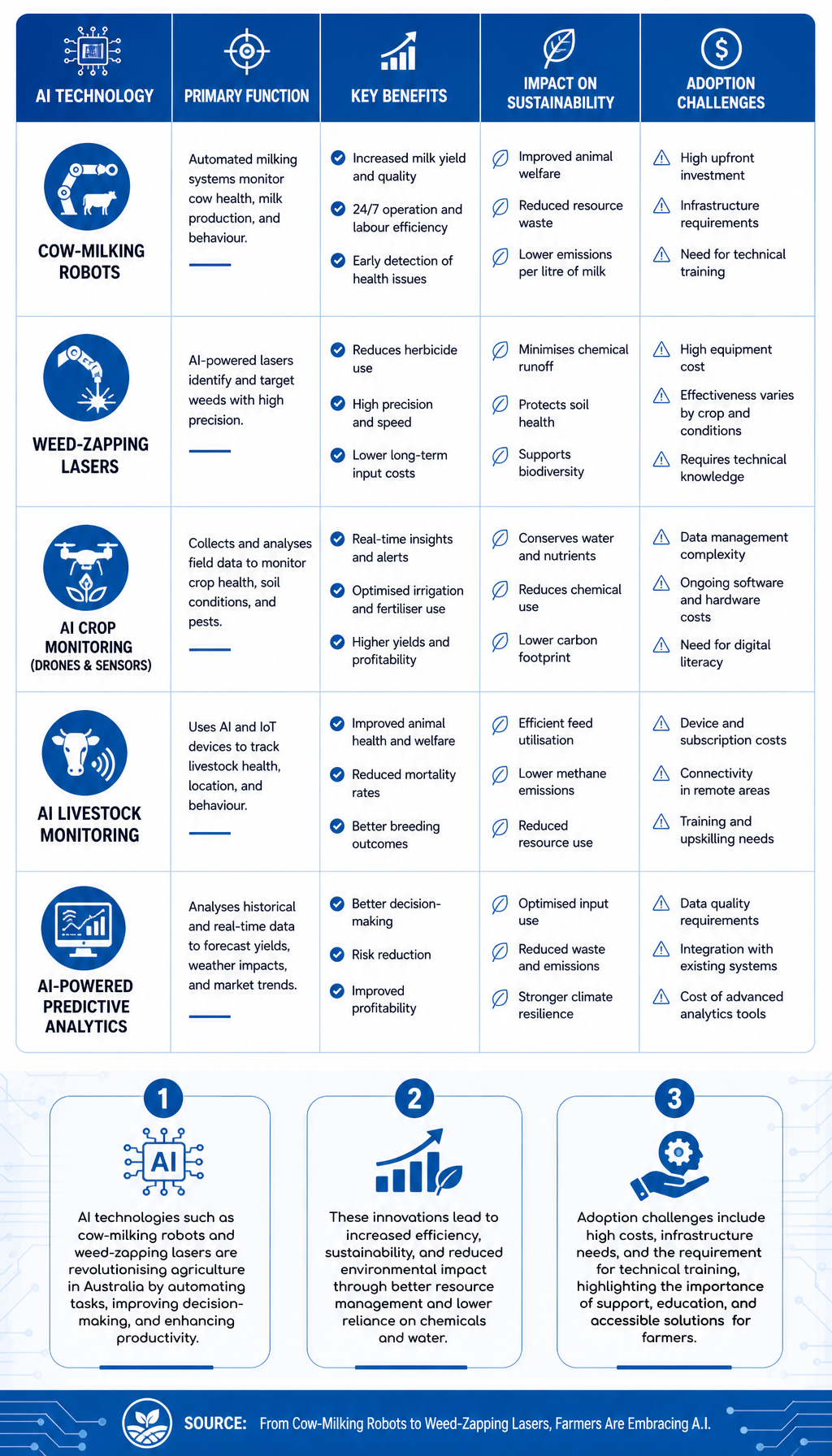
- •AI technologies such as cow-milking robots and weed-zapping lasers are revolutionising agriculture in Australia.
- •These innovations lead to increased efficiency, sustainability, and reduced environmental impact.
- •Adoption challenges include high costs and the need for technical training.
Key Answer
Australian farmers are increasingly adopting AI technologies like cow-milking robots and weed-zapping lasers to enhance farming efficiency and sustainability, marking a significant shift in traditional agricultural practices.
In a landscape where tradition meets innovation, Australian farmers are increasingly turning to cutting-edge technology to boost efficiency and sustainability. From cow-milking robots to weed-zapping lasers, farmers are embracing A.I. to revolutionise agriculture in Australia. This shift is not just a tech upgrade; it represents a seismic change in how farming is conceptualised and executed across the country.
The Role of A.I. in Modern Australian Farming
A.I. technology has made significant inroads into Australian agriculture, offering solutions that address both efficiency and sustainability. The introduction of cow-milking robots exemplifies this trend, providing a glimpse into the future of farming where human labour is supplemented by intelligent machinery. These robots not only automate the milking process but also monitor the health and productivity of each cow, offering farmers data-driven insights to optimise operations.
Weed-zapping lasers are another technological advancement transforming the agricultural landscape. These systems use computer vision and AI to identify and eliminate weeds without the need for chemical herbicides. This not only reduces the environmental impact but also improves crop yield and quality. The adoption of such technologies aligns with the growing demand for sustainable and eco-friendly farming practices in Australia.
Case Studies: Success Stories from Australian Farms
Several Australian farms have already integrated A.I. technologies, with remarkable results. For instance, a dairy farm in Victoria has successfully implemented cow-milking robots, leading to a significant increase in milk yield and a decrease in labour costs. The automated system allows for continuous operation, ensuring cows are milked at optimal times, leading to healthier livestock and higher productivity.
In New South Wales, a grain farm has adopted weed-zapping lasers to combat the persistent issue of herbicide-resistant weeds. This technology has not only reduced the farm’s reliance on chemical herbicides but also improved the overall health of the soil, contributing to better crop yields. These examples highlight how A.I. is not merely a futuristic concept but a practical solution for today’s agricultural challenges.
Expert Perspective
Agricultural Technology Consultant
In the fast-evolving field of agriculture, A.I. is not just an option but a necessity for modern farming. The potential for A.I. to enhance productivity and promote sustainability is immense, yet the transition must be supported by adequate training and financial strategies to mitigate initial costs.
Challenges in Adopting A.I. Solutions
Despite the promising benefits, the adoption of A.I. in agriculture is not without its challenges. The initial investment in technology such as cow-milking robots and weed-zapping lasers can be substantial, posing a barrier for smaller farms with limited financial resources. Additionally, the integration of these technologies requires significant changes in farm management and operations, which can be daunting for those accustomed to traditional methods.
Moreover, there is a learning curve associated with the use of A.I. technologies. Farmers need to acquire new skills to effectively manage and maintain these systems. The need for ongoing technical support and updates is also a consideration, as is the issue of data privacy and ownership—who owns the data generated by these intelligent machines? These challenges underscore the need for supportive policies and training programs to facilitate the transition to A.I.-driven farming.
The Future of A.I. in Australian Agriculture
The future of A.I. in agriculture looks promising, with potential advancements that could further enhance farming efficiency and sustainability. Developments in sensor technology, machine learning, and data analytics are set to provide even more sophisticated tools for precision agriculture. These innovations will enable farmers to make informed decisions about crop management, resource allocation, and environmental conservation.
Furthermore, the integration of A.I. with other emerging technologies such as drones and satellite imagery could open new possibilities for real-time monitoring and management of large agricultural areas. As these technologies continue to evolve, they promise to transform the agricultural sector into a more resilient and sustainable industry, well-equipped to meet the challenges of the 21st century.
Frequently Asked Questions
Cow-milking robots automate the milking process, allowing for increased efficiency and improved herd health monitoring, which leads to higher milk yields and reduced labour costs.
Weed-zapping lasers reduce the need for chemical herbicides, thereby lowering the environmental impact and enhancing soil health, which can improve crop yields.
Farmers face challenges such as high initial investment costs, the need for new skills and training, and concerns over data privacy and ownership.
The future of A.I. in agriculture is promising, with advancements in precision farming tools, sensor technology, and data analytics, paving the way for more efficient and sustainable farming practices.
A.I. contributes to sustainable farming by reducing chemical usage through technologies like weed-zapping lasers and improving efficiency with automation tools like cow-milking robots.