

Key Takeaways
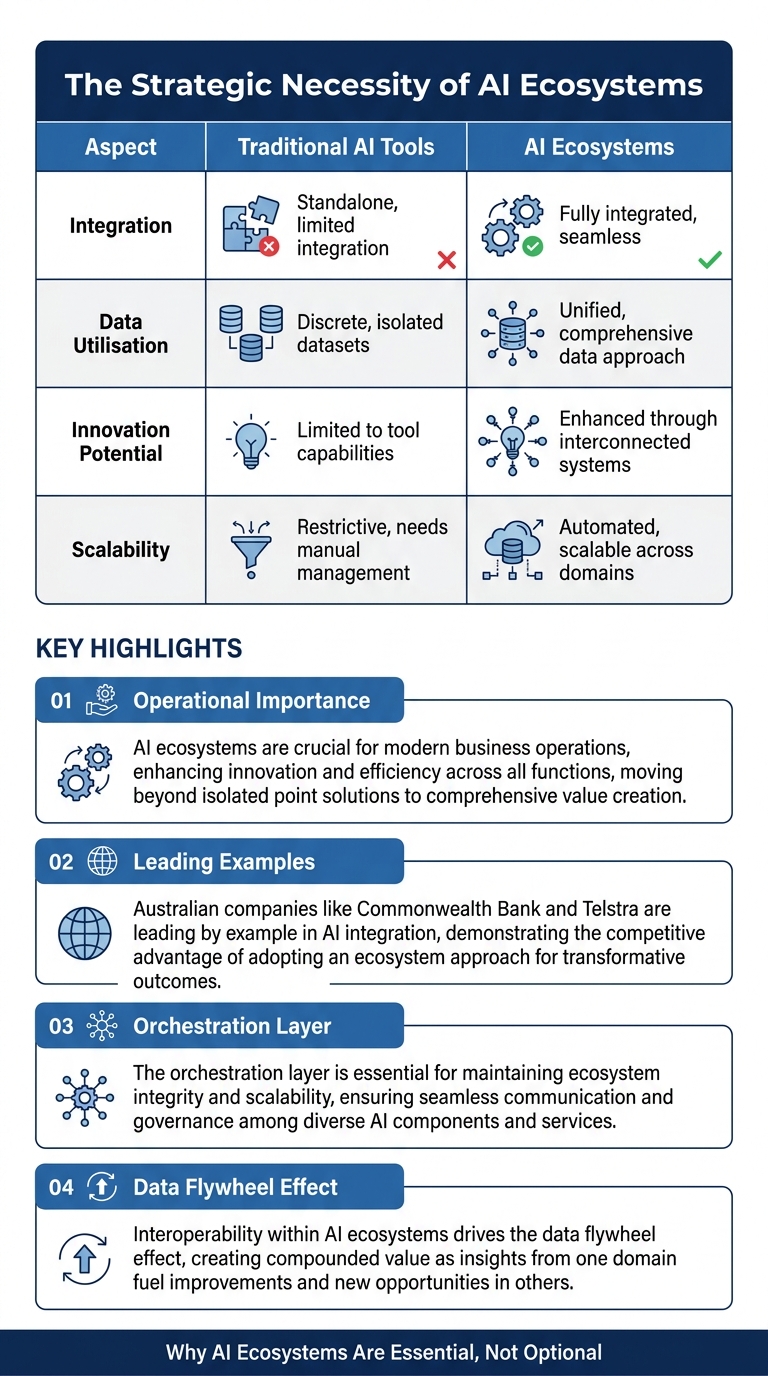
AI ecosystems are crucial for modern business operations, enhancing innovation and efficiency.
Global companies are leading by example in AI integration.
The orchestration layer is essential for maintaining ecosystem integrity and scalability.
Interoperability within AI ecosystems drives the data flywheel effect, creating compounded value.
Key Answer
AI ecosystems integrate diverse tools, driving innovation and efficiency, providing a critical framework for competitive advantage globally.
In a rapidly advancing technological landscape, understanding why AI ecosystems are essential, not optional has become crucial for businesses striving to maintain a competitive edge. These ecosystems provide a structured framework that enhances AI integration, fostering business innovation and driving enterprises towards unprecedented success.
Why AI Ecosystems Drive Business Innovation
AI ecosystems have become the backbone of modern business strategies. Their indispensable role in fostering innovation and improving operational efficiency is undeniable. By orchestrating a seamless interaction among varied AI tools, ecosystems cultivate an environment where business innovation can flourish.
Organisations are increasingly moving beyond isolated AI solutions to construct comprehensive data ecosystems. This shift enhances decision-making and strategic operations, crucially advancing enterprise AI initiatives.
The Strategic Role of AI Integration and Infrastructure
A robust AI infrastructure is integral to the success of AI ecosystems, enabling the seamless integration of AI technologies across various business functions. This foundation is vital for optimising resource use and maximising return on investment.
With a well-designed AI framework, organisations can efficiently manage resources, reduce redundancies, and amplify their capacity for innovation, ensuring sustained growth and scalability. For businesses aiming to remain relevant amid rapid technological advancements, this infrastructure is indispensable.
Case Studies: AI Ecosystems in Action
Leading global enterprises are leveraging AI ecosystems to enhance their operational capabilities. For instance, major banks have significantly improved customer service and fraud detection through AI, demonstrating the transformative potential of these ecosystems.
In the telecommunications industry, companies utilise AI for network management and customer interactions, showcasing how AI integration personalises experiences and anticipates maintenance needs effectively.
Interoperability and the Data Flywheel Effect
Interoperability is a cornerstone of effective AI ecosystems, ensuring a continuous data flow that enriches insights and decision-making. Known as the ‘data flywheel effect,’ this process keeps data relevant and accessible across sectors.
By dismantling data silos, AI ecosystems enable real-time analytics and strategic planning, resulting in more informed and agile decision-making processes.
Future-Proofing with Modular AI Architecture
Incorporating a modular architecture into AI ecosystems is crucial for future-proofing businesses against rapid technological advancements. This approach ensures flexibility, enabling companies to integrate new AI models without disrupting existing operations.
Maintaining a modular AI infrastructure allows businesses to swiftly adapt to emerging trends and technological shifts, ensuring long-term viability and competitive advantage.
Frequently Asked Questions
AI ecosystems are integrated networks of AI tools and technologies that work together to enhance business operations, innovation, and efficiency.
They foster innovation, improve efficiency, facilitate collaboration, and provide a framework for strategic decision-making and competitive advantage.
Global companies benefit by integrating AI ecosystems to remain competitive worldwide, enhancing operational capabilities and innovation.
It manages and integrates various AI tools, facilitating communication and data exchange to maintain ecosystem functionality and scalability.
It refers to the self-reinforcing cycle where data flows continuously, creating compounded value and insights within an AI ecosystem.